Short answer: working capital is what turns into cash within a year minus what you owe within a year: current assets minus current liabilities. Divide the same two numbers instead and you get the current ratio. Under 1 is a warning, and between 1.2 and 2 is often seen as healthy.
A business can post a profit every month and still struggle to pay its suppliers, because profit does not tell you whether the money has arrived. Working capital looks at the balance sheet and asks a simpler question: if everything due this year came due, would what you have cover it?
How do you calculate working capital?
Add up everything you expect to turn into cash within a year, then everything you expect to pay within a year. The numbers below are made up for the example:
| Current assets | Amount | Current liabilities | Amount |
|---|---|---|---|
| Cash | 40,000 | Suppliers | 90,000 |
| Unpaid customer invoices | 130,000 | Short-term loan | 60,000 |
| Stock | 80,000 | Tax and wages due | 30,000 |
| Total | 250,000 | Total | 180,000 |
Working capital = 250,000 - 180,000 = 70,000. That is the cushion left after everything due this year is paid, as long as the assets really do turn into cash.
What does the current ratio tell you?
The current ratio divides instead of subtracts: 250,000 / 180,000 = 1.39, so there is 1.39 in short-term assets for every 1 owed. Dividing lets you compare a small company with a big one, or this year with last year, which an amount cannot do.
| Current ratio | How to read it |
|---|---|
| Under 1 | A warning: it can mean trouble paying bills |
| 1.2 to 2 | Often seen as healthy |
| Far above 2 | Look for cash sitting idle in stock and unpaid invoices |
These are rules of thumb, not laws. A shop that collects at the till before it pays its suppliers can run lower than a manufacturer without being in trouble, so compare with your own past and with similar businesses.
Why can you have working capital and still run out of cash?
Because most of it may not be cash. Unpaid invoices count as current assets, but they cannot pay today's bills. In the example, 130,000 of the 250,000 is money customers still owe and 80,000 is stock nobody has bought yet. Take those away step by step and the picture changes:
| Measure | Sum | Result |
|---|---|---|
| Current ratio | 250,000 / 180,000 | 1.39 |
| Quick ratio (leave out stock) | 170,000 / 180,000 | 0.94 |
| Cash only | 40,000 / 180,000 | 0.22 |
A healthy current ratio with a thin cash line means the next step is to chase invoices, not to celebrate. Profit vs cash flow covers the same trap from the income side.
Can working capital be negative?
Yes. It goes negative when you owe more within a year than you can turn into cash within a year, which is the same thing as a current ratio under 1. For most businesses that is a warning. The exception is a business that collects before it pays: some retailers run on suppliers' credit for this reason.
What goes wrong when you read it?
- Reading the amount without revenue. As a business grows, so does working capital. Look at it as a share of revenue over time.
- Counting slow stock at full value. Stock that has sat for a year may never sell for what the balance sheet says.
- Forgetting that more is not always better. Too little and bills go unpaid, too much and cash sits idle.
- Improving it the wrong way. Paying suppliers later than agreed makes the cash line look better for a month and costs you the supplier's goodwill.
What is the formula in DAX, SQL and Excel?
Working Capital = [Current Assets] - [Current Liabilities]
Current Ratio = DIVIDE ( [Current Assets], [Current Liabilities] )SELECT month,
current_assets - current_liabilities AS working_capital,
current_assets / NULLIF(current_liabilities, 0) AS current_ratio
FROM monthly_balance;=CurrentAssets - CurrentLiabilities
=CurrentAssets / CurrentLiabilitiesWhere can you check this?
- U.S. SEC: Beginners' Guide to Financial Statements, for current assets, current liabilities and the working capital formula
Can you get the related KPIs for your report?
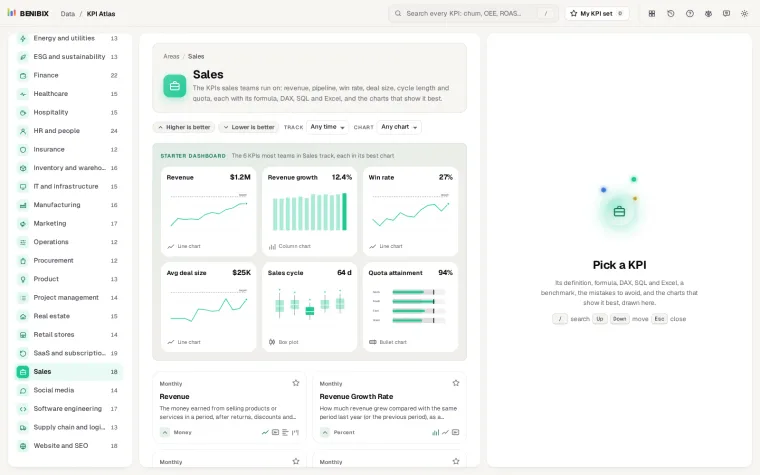
KPI Atlas has working capital, the current ratio, the quick ratio and the cash conversion cycle, each with its definition, its formula in DAX, SQL and Excel, the mistakes to avoid and the charts that show it. Start with working capital as a line against revenue, then add the current ratio with a band for the healthy range.