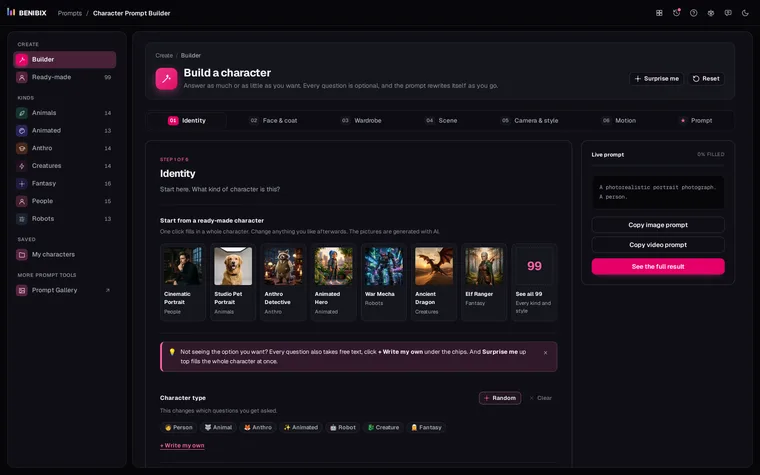
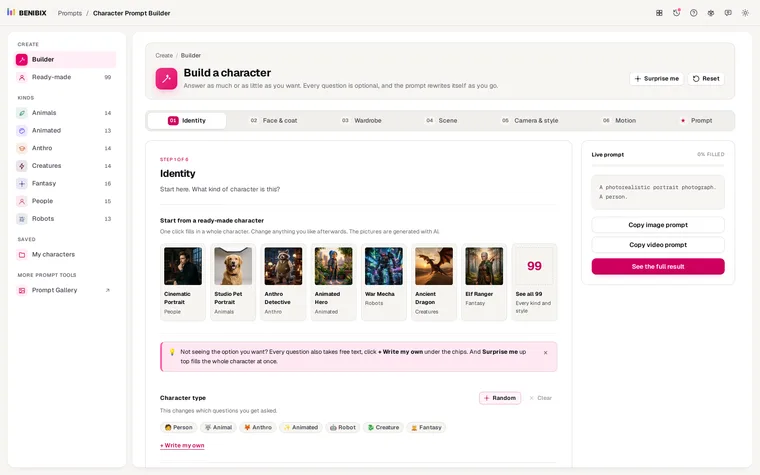
Short answer: a character prompt that works names the style and framing first, then describes only the character (who, body, face, clothes), then the expression, the place and light, the mood, and last the lens and finish. Below are eight real examples in that order, for a person, an animal, an anthro, a robot, a creature, a fantasy race and an animated character, each ready to copy.
Every example here is the exact prompt Character Prompt Builder writes for one of its 99 ready-made characters. Pick the same character there and you get the same words, already shaped for your model.
What are the seven parts of a character prompt?
- Style and framing. "A cinematic film still, close-up portrait." This sets the whole look, so it goes first.
- The character. Kind, age, build. "A 34-year-old South Asian woman, average build."
- Face and features. Skin, hair, eyes, one or two marks that make them recognisable.
- Clothes. Outfit, accessories, footwear. People read a new outfit as a new character.
- Expression. One clear expression, not a list.
- Place, light and mood. Where they are, when, how it is lit, how it feels.
- Camera and finish. Lens, focus, grain, and the aspect ratio.
Parts 2 to 4 are the identity block: the words you keep the same in every later prompt. Everything else can change from picture to picture. How to keep an AI character consistent explains why that split matters.
How do you prompt a person, such as a corporate headshot?
A minimal studio portrait, close-up portrait. A 34-year-old South Asian
woman, average build. They have golden tan skin, warm chestnut hair in a
sleek high ponytail, hazel eyes. Wearing a monochrome minimalist blazer set,
with classic metal-frame glasses, in polished leather loafers. Their face
carries a warm charismatic smile. In a modern Nordic office, under soft
overcast daylight, lit by soft natural window light. The overall mood is calm
and serene. Shot on an 85mm f/1.4 lens, hyper-detailed skin texture,
tack-sharp focus on the eyes and creamy bokeh background. Aspect ratio: 1:1.Why it works: a real lens (85mm), a real light source (window, overcast) and "skin texture" are what push a model from plastic to photograph. Footwear is in the identity block even though the crop hides it, so a full-body shot later shows the same shoes.
How do you prompt an animal, such as a studio pet portrait?
A minimal studio portrait, close-up portrait. An adult Golden Retriever dog,
thick-furred and fluffy. It has golden fur, a solid, unmarked coat, deep
brown eyes. Wearing a collar with a brass name tag. Mouth open in a happy
pant. In a seamless studio backdrop, in bright midday light, lit by clean
studio softbox lighting. The overall mood is joyful and energetic. Shot on
an 85mm f/1.4 lens, hyper-detailed individual fur strands, tack-sharp focus
on the eyes and creamy bokeh background. Aspect ratio: 1:1.For animals, the breed does more than any adjective. "Golden Retriever" fixes the head shape, ears and coat length in two words. The expression is written as what the animal does ("mouth open in a happy pant"), not as a human face.
How do you prompt an anthro, such as a raccoon detective?
A charming Pixar-style 3D animated character render, medium shot. An adult
anthropomorphic raccoon, stocky and heavy-set, standing upright on two legs
like a person. They have silver grey fur, a dark mask across the face, amber
eyes. Wearing a tweed waistcoat with a brass pocket watch, with small brass
flight goggles, in black oxford dress shoes. Their face carries a subtle
confident smirk. In a luxurious glass-walled library, at night, lit by warm
candlelight. The overall mood is mysterious and enigmatic. Hyper-detailed
individual fur strands, shallow depth of field and cinematic colour grading.
Aspect ratio: 1:1."Standing upright on two legs like a person" is the line most anthro prompts forget. Without it, many models draw a raccoon on four legs next to a waistcoat.
How do you prompt a robot, such as a garden droid?
A charming Pixar-style 3D animated character render, full body shot. A boxy
utility droid, a rugged industrial frame. It has rusted salvaged iron
plating, glowing green optical sensors, moss growing in the seams and a
dented watering can in one claw. Optics scanning intently. In a wildflower
meadow, at golden hour, lit by strong backlighting with lens flare. The
overall mood is whimsical and playful. Shallow depth of field and cinematic
colour grading. Aspect ratio: 1:1.Robots need materials, not skin: plating, finish and the colour of the optics. "Eyes" become "optical sensors", and one story detail (the moss, the watering can) gives the machine a personality.
How do you prompt a creature, such as a moss golem?
A classical oil painting, full body shot. A stone golem, a hulking muscular
mass. It has cracked rocky hide, empty void-black eyes, thick moss and small
ferns growing from its shoulders. With glowing runes etched into its body. A
menacing predatory glare. In a misty pine forest, at early sunrise, lit by
strong backlighting with lens flare. The overall mood is mysterious and
enigmatic. Aspect ratio: 1:1.A painted style has no lens, so the camera part is left out. The surface ("cracked rocky hide") and one glowing detail do the work a face does for a person.
How do you prompt a fantasy race, such as a tiefling sorcerer?
An anime-style illustration, cowboy shot from mid-thigh up. A 22-year-old
tiefling woman, slim build. They have deep red infernal skin, jet black hair
in long waves, amber eyes, curled black horns and a thin tail. Wearing a
high-collared indigo robe with silver embroidery, violet fire curling in one
palm, in worn leather boots. Their face carries a subtle confident smirk. In
a luxurious glass-walled library, at night, lit by warm candlelight. The
overall mood is mysterious and enigmatic. Aspect ratio: 1:1.Name the race, then describe it anyway. "Tiefling" alone gives a model a vague idea; red skin, horns and a tail make sure all three appear every time.
How do you prompt an animated character, such as a claymation kid?
A stop-motion claymation still, full body shot. A stop-motion claymation
animated kid character, round and squishy. They have warm beige skin, copper
red hair in a messy tousled style, deep brown eyes, freckles and a missing
front tooth. Wearing a bright yellow raincoat, in red wellies. Their face
carries a huge exaggerated toothy grin. In a misty pine forest, under soft
overcast daylight. The overall mood is whimsical and playful. Aspect ratio:
1:1.For cartoons, say the medium twice: once as the style and once in the character ("claymation animated kid"). Proportions ("round and squishy") matter more than an age in years.
How do you prompt a character sheet?
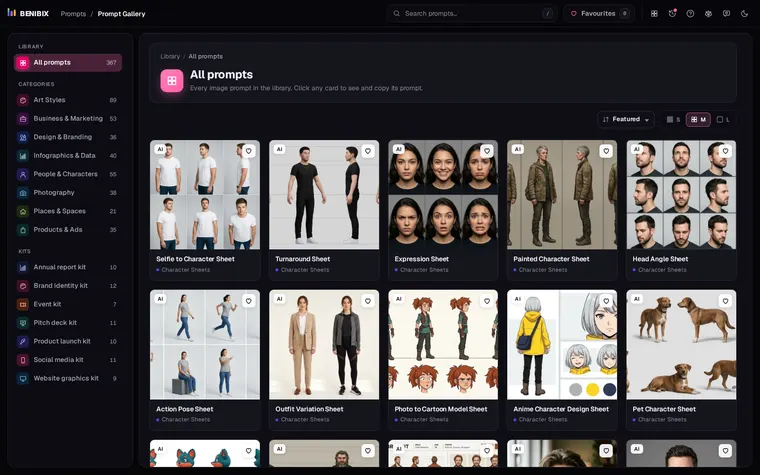
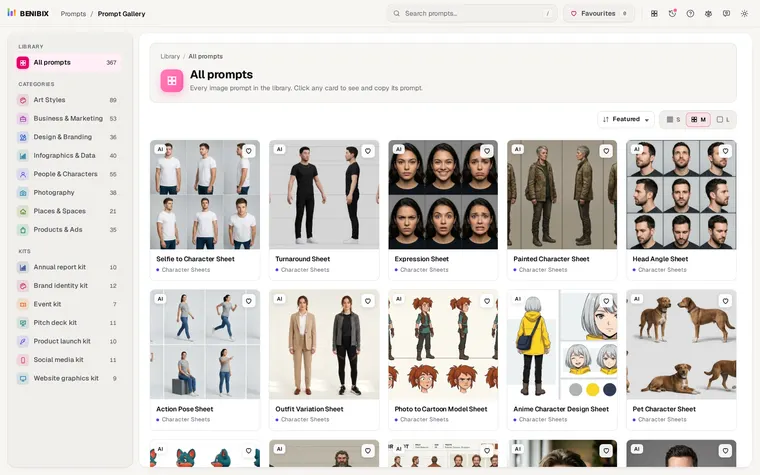
A character sheet shows the same character from several views on one image. It is the best reference to attach when you need the character again.
A character concept sheet with multiple views, full body shot. A 34-year-old
Latino woman, athletic build. They have golden tan skin, auburn hair in a
sleek high ponytail, amber eyes, a compass tattoo on the inner wrist.
Wearing cargo pants with a cropped top, with a waterproof technical
backpack, a classic buckled leather belt and a chronograph wristwatch, in
black combat boots. Their face carries a subtle confident smirk. In a
seamless studio backdrop, lit by clean studio softbox lighting. The overall
mood is confident and bold. Aspect ratio: 1:1.The same works for an anthro or a robot: swap the identity block and keep the plain backdrop and soft light. How to make an AI character sheet goes further, with turnarounds and expression sheets.
What do you change for your model?
- Flux, GPT Image, Firefly, Nano Banana: use the prompts as written. They read whole sentences well.
- Midjourney: shorten the sentences to comma-separated phrases and put the aspect ratio in a flag, such as
--ar 1:1 --v 7. - Stable Diffusion (SDXL, SD 1.5): turn it into lowercase tags and add a negative prompt for what goes wrong with that kind of character, such as extra fingers for people or extra legs for animals. Negative prompts explained covers which models still use one.
Character Prompt Builder does this rewrite for you: pick a prompt style on its last step and the same character comes out as prose, phrases with flags, or tags.
Where can you check this?
- Midjourney documentation
- Black Forest Labs (Flux) documentation
- Google AI for Developers: Image generation with Gemini
How do you make your own?
The fastest way to a prompt like these is to start from one. Open the ready-made characters, filter by kind and art style, pick the closest one and change what is different. Every question in the builder adds the words for one part above, in the right order, and the free course walks through it from the first character to a library you can reuse.