Short answer: Say which kind of logo you want (a wordmark, a pictorial mark, an abstract mark or an emblem), put the brand name in quotes, name one or two colours, and ask for a flat vector on a white background with no extra text. "A clean modern wordmark logo spelling "Lumen" in a bold typeface, letters slightly tightened, deep teal on a white background, no icon, no tagline, flat vector" gives you a usable logo; "a logo for my company" gives you clip art.
AI image models are good at logos when you tell them what a logo is. Leave it open and they draw a whole scene: a gradient, a shadow, three made-up words and a tagline nobody asked for. The fixes are all in the prompt.
Which kind of logo should you ask for?
| Kind | What it is | Good for |
|---|---|---|
| Wordmark | The name itself, set in a distinctive typeface | A short name you want people to remember |
| Pictorial mark | A simple picture of something (a bulb, a leaf) | A name that is long or hard to read small |
| Abstract mark or monogram | A shape or a letter that stands for the brand | App icons, favicons, social profile pictures |
| Emblem | Name and picture inside a badge, seal or crest | Packaging, stamps, merch, a traditional feel |
Most brands end up with two: a wordmark for the website header and a mark that still reads at 32 pixels for the app icon and favicon.
What does every logo prompt need?
- The kind of logo, in the first words: "a wordmark", "a pictorial mark", "a monogram".
- The name in quotes, exactly as it should be spelled:
"Lumen". - One or two colours by name or hex code. More colours look busy and print badly.
- The finish: "flat vector", "no gradients", "no shading", "white background". These keep it usable as a real logo.
- What to leave out: "no icon", "no tagline", "no other lettering". Without this, models add words.
- A line that keeps it original: "do not copy any existing logo or trademarked design".
Logo prompts to copy
Each prompt below is from Prompt Gallery; replace the parts in square brackets. The picture under each is what it made for a sample brand, Lumen, in teal and coral.
A modern wordmark:
A clean modern wordmark logo spelling "[Your Brand]" in a bold [heading font]-style typeface, letters slightly tightened, [primary brand colour] on a white background, no icon, no tagline, flat vector, generous whitespace. Keep it original: do not depict any celebrity or real public figure, and do not copy any existing painting, artwork, film or game character, mascot, logo or trademarked design.A single line icon:
A minimalist pictorial mark for [Your Brand]: a single line icon representing what the brand does, simple geometric shapes, flat vector illustration style, [primary brand colour] fading to [accent colour], no text, white background, symmetrical, balanced, app-icon ready. Keep it original: do not depict any celebrity or real public figure, and do not copy any existing painting, artwork, film or game character, mascot, logo or trademarked design.A bold monogram:
A monogram logomark using the first letter of "[Your Brand]", constructed from bold geometric strokes, [primary brand colour] on white, no additional text, flat vector, symmetrical, app-icon ready. Keep it original: do not depict any celebrity or real public figure, and do not copy any existing painting, artwork, film or game character, mascot, logo or trademarked design.A friendly mascot:
A friendly mascot-style icon mark for [Your Brand], rounded geometric shapes, [accent colour] as the main color with [neutral brand colour] accents, no text, flat vector, centered, white background. Keep it original: do not depict any celebrity or real public figure, and do not copy any existing painting, artwork, film or game character, mascot, logo or trademarked design.A vintage emblem:
A vintage-inspired circular emblem for "[Your Brand]", the brand name in [heading font]-style lettering along the top of the badge ring and small stars along the bottom, no other lettering, a simple central icon, [primary brand colour] line work on white, no photographic detail, flat vector suitable for stamps or packaging. Keep it original: do not depict any celebrity or real public figure, and do not copy any existing painting, artwork, film or game character, mascot, logo or trademarked design.Why does the AI misspell the brand name?
Image models draw letters as shapes, and a long or unusual name gives them more chances to slip. What helps:
- Keep the name in quotes and spell it exactly, with the capitals you want.
- Ask for the name once. "The name along the top and nowhere else" stops it from repeating the word with typos.
- Try a model that sets text well. The gallery's logo prompts are written for Ideogram, Recraft, Nano Banana and Midjourney.
- Or leave the name out. Generate the mark with "no text", then set the name next to it yourself in a real font. The letters are then perfect and you can change them later.
Can you use an AI logo for your business?
You can use it, but think about what you can protect. The US Copyright Office concluded in January 2025 that protection does not extend to "the mere provision of prompts"; it can apply where "a human makes creative arrangements or modifications of the output." So a logo you redraw and refine yourself is on firmer ground than one you download as it came.
A trademark is a separate question from copyright: before you print the logo on anything, search your country's trademark register for similar names and marks in your field.
What should you do before you use it?
- Redraw it as a vector. Image models give you pixels. Trace the logo into an SVG (by hand or with a tracing tool) so it stays sharp at any size; SVG or PNG for icons explains why.
- Test it small. Shrink it to 32 and 16 pixels, the sizes of an app icon and a favicon. If it turns into a blob, simplify it or use the monogram there.
- Make a one-colour version for stamps, embroidery and fax-quality prints, and a light version for dark backgrounds.
- Check it is not someone else's. A reverse image search and a trademark search take ten minutes.
Where can you check this?
Where can you find more logo prompts?
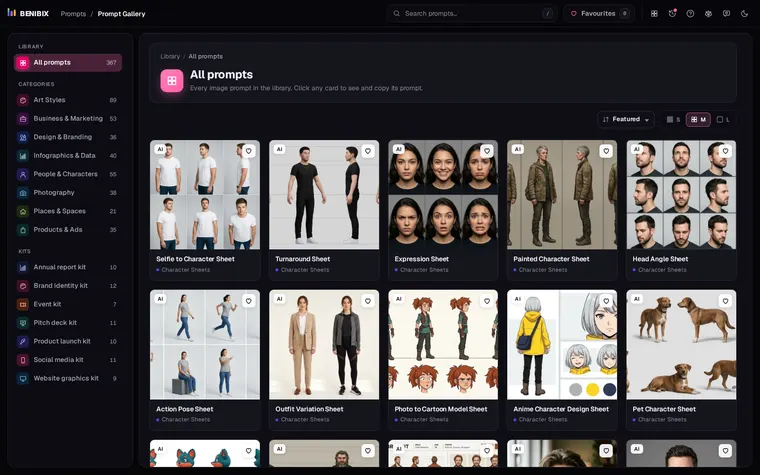
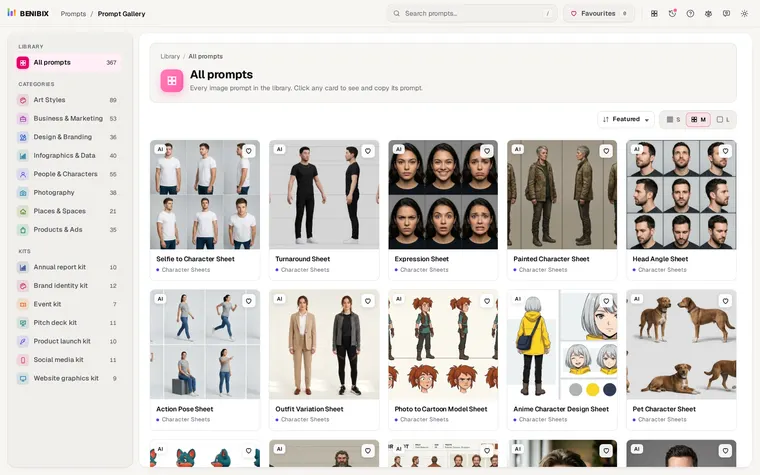
Prompt Gallery has 16 logo prompts in four groups (wordmarks, pictorial marks, abstract marks and emblems), each next to the logo it made. Open one and use Customize to fill in your name, colours and heading font from a saved brand kit, and the Brand identity kit takes a logo direction on to stationery, signage and merch.