Short answer: there is no single best AI image model. Pick by the job: Midjourney for a striking look or an art style, Flux for a precise, photoreal scene from a long description, Nano Banana (Gemini) for editing a photo you already have while keeping the face or product, and GPT Image or Ideogram when the picture needs words that are spelled right.
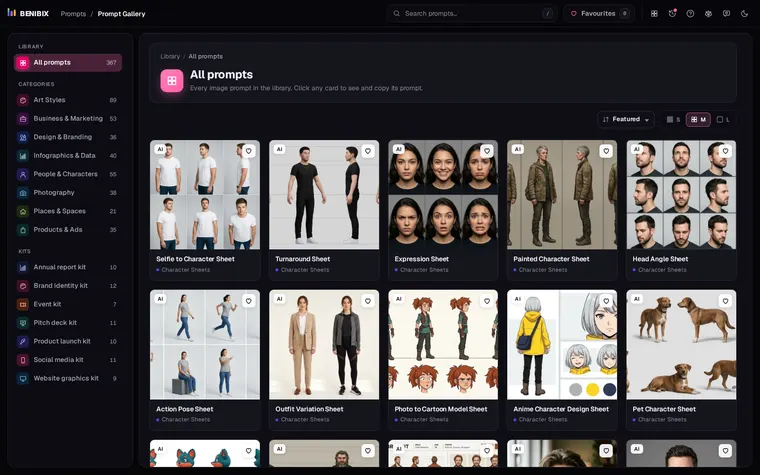
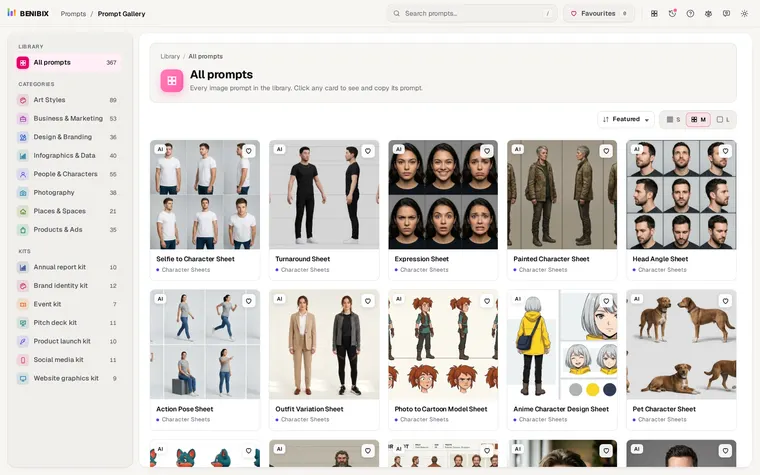
This comparison comes from writing and testing the 367 prompts in the Prompt Gallery, where each prompt lists the models it was written for. Models get new versions every few months, so the strengths below are the stable ones, not the benchmark of the week.
Which model for which job?
| Job | First choice | Also good |
|---|---|---|
| A striking look, an art style, a mood board | Midjourney | Flux |
| A photoreal scene that matches a long description | Flux | Imagen, GPT Image |
| Edit your own photo, keep the face or the product | Nano Banana | GPT Image, Flux Kontext |
| Headshots and portraits from a selfie | Nano Banana | GPT Image, Flux Kontext |
| Product packshots from your product photo | Nano Banana | Flux Kontext, Firefly |
| Text in the image: posters, slides, infographics | GPT Image | Ideogram, Nano Banana |
| Logos and wordmarks | Ideogram | Recraft, GPT Image |
| Run it on your own computer, no subscription | Flux (open weights), Stable Diffusion | |
| Safe for commercial use by policy | Firefly |
In the gallery, Nano Banana is listed on 258 prompts, Midjourney on 234, Flux on 196, Imagen on 139, Ideogram on 112 and GPT Image on 98. Most prompts work on several models.
When is Midjourney the right choice?
Midjourney makes good-looking pictures from short prompts. Its defaults lean towards strong light, rich colour and a finished, "art directed" feel, which is why it is the favourite for mood boards, album covers, fantasy and illustration.
- Write it as: short phrases, then parameters.
--ar 4:5sets the shape,--noleaves things out,--style rawturns the house style down for photos. - Strong at: styles, lighting, composition, variety.
--srefcopies the style of a reference image. - Weaker at: following a long list of exact details, and spelling longer text.
- Cost: paid plans only.
When is Flux the right choice?
Flux, from Black Forest Labs, follows long, specific descriptions closely. If you write "a green mug on the left, a teapot on the right, a folded napkin under the mug", that is usually what you get.
- Write it as: full sentences, subject first.
- Strong at: photoreal scenes, getting the details and their positions right, and reasonable text on objects.
- Weaker at: a distinctive look out of the box. You describe the style rather than get one for free.
- Extras: open-weight versions run on your own GPU, and Flux Kontext edits an existing image from an instruction.
When is Nano Banana the right choice?
Nano Banana is the nickname for Google's Gemini image model. Its strength is working from images you give it: change the background, change the clothes, put your product in a room, merge two photos, and keep the person or the object recognisably the same.
- Write it as: plain instructions. "Put the product from the photo on a pure white background. Keep its shape, colour and label exactly as they are."
- Strong at: keeping identity across edits, step-by-step changes in a conversation, combining several reference images.
- Weaker at: some art styles look generic next to Midjourney.
- Cost: available in the Gemini app, including a free tier with limits.
When is GPT Image the right choice?
GPT Image is OpenAI's image model, inside ChatGPT and the API. It follows detailed instructions well and is one of the best at text in images: slide titles, infographic labels, signs and menus.
- Write it as: sentences, like a brief to a designer. Quote any words that must appear.
- Strong at: layouts with text, infographics, diagrams, editing with a reference.
- Weaker at: speed, and a limited set of output sizes (square, landscape 3:2 and portrait 2:3).
- Note: it rewrites your prompt internally, so say clearly what must not change.
What about Ideogram and the others?
- Ideogram was built for typography. It is a strong pick for logos, posters and anything where the letters are the point, and it has a negative prompt field.
- Imagen is Google's text-to-image model: clean, photoreal, good at following prompts.
- Recraft makes vector-style graphics and icons and can export SVG.
- Firefly, from Adobe, is trained on licensed and public domain content, which some companies require.
- Stable Diffusion and SDXL run locally with full control (negative prompts, seeds, LoRAs), but take more setup and more prompt skill.
How do you write one prompt for four models?
The subject and the details stay the same. The form changes.
Flux (sentences):
A ceramic coffee mug, matte sage green, on a scrubbed oak table by a
window. Editorial product photograph, soft morning light from the left,
close-up, shallow depth of field.Midjourney (phrases and parameters):
matte sage green ceramic mug, oak table by a window, editorial product
photo, soft morning window light, close-up, shallow depth of field
--ar 4:5 --style raw --no textNano Banana (an instruction, with your photo attached):
Place the mug from my photo on a scrubbed oak table by a window, soft
morning light from the left. Keep the mug's shape, colour and chip on
the rim exactly as they are.GPT Image (a brief, text quoted):
Create a 2:3 poster: the sage green mug on an oak table by a window,
soft morning light. At the top, the headline "Slow Mornings" in a
clean serif. No other text.How do you choose in practice?
- Do you start from your own photo? Use Nano Banana, GPT Image or Flux Kontext.
- Must the picture contain words? Use GPT Image or Ideogram, and quote the words.
- Is the look more important than exact details? Use Midjourney.
- Is the exact scene more important than the look? Use Flux.
- Must it run offline or cost nothing per image? Use Flux open weights or Stable Diffusion.
When two models fit, run the same prompt on both. A tested prompt tells you more in a minute than any comparison chart.
Where can you check this?
- Midjourney documentation
- Black Forest Labs (Flux) documentation
- Google AI for Developers: Image generation with Gemini
- OpenAI API docs: Image generation
What is the short version?
- Midjourney for looks, Flux for precision, Nano Banana for editing your own photos, GPT Image and Ideogram for text.
- The parts of a prompt stay the same across models; the form changes: phrases and parameters, sentences, or instructions.
- Choose by the job, then test the same prompt on two models.
Every prompt in the Prompt Gallery lists the models it was written for, and you can type a model name into the search to see only its prompts. For the order of words inside a prompt, see how to write an image prompt that works, and for what to leave out, see negative prompts explained.