Short answer: A good image prompt names the subject, the setting, the light, the style, the shape of the picture and what to leave out, in plain sentences. "A cinematic Halloween night portrait of the subject from the reference photo in a handmade costume, on a front porch lined with glowing carved pumpkins, low fog, blue dusk, 50mm photo, no text, aspect ratio 4:5" gives you a picture you can post. "Halloween photo of me" gives you a guess. Copy one of the prompts below, attach your photo if it asks for one, and change the words you want different.
Most people searching for image prompts have already tried a few lines of their own and got something flat, strange or nothing like the idea in their head. The quickest fix is to start from a prompt whose result you have already seen and change only what you need. Every prompt in this post comes from Prompt Gallery and is shown with the image it actually made.
What does a good image prompt have in it?
Google's guide for its Gemini image models (the ones called Nano Banana) puts it simply: "Describe a scene in rich detail. The more specific you are, the more control you have over the results." In practice that means six parts, in about this order:
| Part | What it says | In the Halloween prompt |
|---|---|---|
| Subject | Who or what, and what they are doing | The person from your photo, in a handmade costume |
| Setting | Where, with two or three real details | A front porch, carved pumpkins, paper bats on the railing |
| Light and mood | The time of day and how it feels | Warm candlelight against deep blue dusk, playful and spooky |
| Style | Photo, painting, 3D, poster; for photos, the lens | Cinematic portrait, shallow depth of field, 50mm |
| Shape | The aspect ratio | 4:5, the tall size for an Instagram post |
| Leave out | What must not appear | No text, no watermark |
A prompt with all six in plain sentences beats a pile of keywords like "8K, masterpiece, trending". If you want to go deeper into each part, image prompts that work in Midjourney, Flux and Nano Banana takes them apart one by one.
Do you need your own photo?
For any prompt about you, yes. The best results put a real person in a new scene, and the models do that from a photo you attach: in Google's words, you "provide an image and use text prompts to add, remove, or modify elements, change the style, or adjust the color grading." That is why many prompts below start with "the subject from the reference photo". Attach one clear, well-lit photo of the face, and the model keeps the face and changes everything else.
Without a photo, the same prompt invents a stranger. If that is what you want, replace "the subject from the reference photo" with a short description ("a woman in her thirties with short curly hair"). Only use photos of people who agreed to it.
The prompts in this post are shortened by one line: in the gallery every one of them ends with "Keep it original", a sentence that tells the model not to copy a celebrity, a famous artwork or a logo. Leave it in when you copy from the gallery. It costs nothing and stops the most common reason a model refuses or draws something you cannot use.
Which holiday photo prompts can you try this season?
A holiday photo you never took is one of the easiest wins: one photo of you, one prompt, and you are on the porch or by the tree. These two are from the gallery's new Holidays & Events category.
Halloween night portrait:
A cinematic Halloween night portrait of the subject from the reference photo in a handmade costume of their own design, standing on a front porch lined with carved glowing pumpkins. Drifting low fog, warm candlelight on the face against a deep blue dusk, paper bats strung along the railing, playful spooky mood, shallow depth of field, 50mm photo. No text, no watermark. Aspect ratio 4:5.Christmas morning:
A candid Christmas morning portrait of the subject from the reference photo in a cosy knitted jumper, sitting on the floor beside a decorated tree and half-opened wrapped gifts. Fairy-light bokeh, soft morning light through a frosted window, a mug of hot chocolate in hand, warm tungsten glow, joyful relaxed expression, editorial lifestyle photography. No text, no watermark. Aspect ratio 4:5.The Holidays tab has 16 of these, from Diwali, Eid, Hanukkah and Lunar New Year to Day of the Dead, Thanksgiving and New Year's Eve. Next to it, Milestones has a birthday, a graduation, prom and a maternity shoot, and Weddings & Love has an engagement shoot and a golden hour wedding portrait.
Which prompts give you a whole new look?
Trying a haircut or a style on your own face before you commit is one of the most useful things an image model can do.
Nine hairstyles at once:
A 3x3 grid of the subject from the reference photo trying nine hairstyles: a buzz cut, a bob, long waves, curtain bangs, a sleek ponytail, curly volume, a pixie cut, braids and fully bald. Same face, light and angle in every tile, clean studio background. No text, no watermark. Aspect ratio 1:1.The line "Same face, light and angle in every tile" does the real work: without it, each tile gets a different pose and you cannot compare them. Change the list of nine to the cuts you are really thinking about.
An aesthetic, such as old money:
An old money style editorial of the subject from the reference photo in a cable-knit sweater over a crisp shirt, on the lawn of a country club beside a vintage convertible. Golden afternoon light, navy cream and green palette, relaxed elegance, soft film grain, no logos. No text, no watermark. Aspect ratio 4:5.An aesthetic is a palette plus a handful of objects and a setting. Name all three and the model gets it. Fashion Aesthetics has 14 of them (coquette, cottagecore, dark academia, quiet luxury, gorpcore and more), and Makeovers & Try-Ons has a glow-up, an outfit try-on, a personal colour analysis, a makeup guide and an age shift.
How do you turn a photo into art?
Name the art form and its materials, not an artist. "Glazed porcelain with blue ink patterns" or "soft-edged blocks of colour in thin washes" tells the model what to make; a famous name mostly gets you a refusal or a copy.
A witch in her cottage:
The subject from the reference photo as a witch in a dark velvet cloak and a wide-brimmed hat, stirring a glowing green potion in a candlelit cottage full of dried herbs, jars and old books. A black cat on the shelf, warm and mysterious, fantasy portrait. No text, no watermark. Aspect ratio 4:5.A colour-field painting:
A portrait of the subject from the reference photo set against large soft-edged blocks of glowing colour in deep red and orange, in the manner of mid-century colour-field painting. Thin washes of paint, quiet meditative mood, the figure painted simply and calmly. No text, no watermark. Aspect ratio 4:5.A porcelain figurine:
The subject from the reference photo as a glazed porcelain figurine painted with delicate blue ink patterns of flowers and waves. Glossy white china, fine hairline crackle, soft museum light on a dark velvet plinth, elegant still-life render. No text, no watermark. Aspect ratio 4:5.Art Styles is the biggest category in the gallery, with 142 prompts in 14 tabs: Horror has the witch, a vampire and a werewolf, Modern & Abstract has cubism and op art, Toys & Clay has clay, bricks, gummy candy and porcelain, and 3D Render, Anime & Manga, Painting and Print & Poster Art cover the rest. For the boxed toy version of yourself, the action figure prompt has its own post.
Which prompts put words in the picture?
Text is where image prompts most often go wrong. Google's advice is to be "clear about the text, the font style (descriptively), and the overall design." The gallery's text prompts go one step further: they list every word the picture may contain, and forbid all others.
A meme from your photo:
A classic image meme of the subject from the reference photo making an exaggerated deadpan expression at a cluttered office desk, with bold white impact-style text with black outline at the top and the bottom. Text: the only words in the image are exactly "ME AT 9 AM", "ME AT 9:05 AM". Spell every word exactly as written, large enough to read on a phone. No other words, letters or numbers, no placeholder text, no watermark. Aspect ratio 1:1.Your own video game cover:
A football video game cover with the subject from the reference photo as the cover star, celebrating a goal in a stadium with flares and confetti. Dramatic lighting, sports-game box-art style, original kit with no real club or sponsor, the title at the top. Text: the only words in the image are exactly "STRIKER 27". Spell every word exactly as written, large enough to read on a phone. No other words, letters or numbers, no placeholder text, no watermark. Aspect ratio 3:4.Change the words in quotes to yours: your own captions, your name and number. Keep them short, because every extra word is another chance for a typo. The new Sports tab also has a sticker card, a fight-night poster and the stadium big screen, and AI infographic prompts that spell every word right and AI logo prompts go further into text in images.
Which prompts work with no photo at all?
Places, worlds and objects need no reference: the prompt is the whole picture. These are good to test a new model with, because you can judge the result without worrying about likeness.
An underwater sunken city:
An underwater sunken city: domed towers and marble arches overgrown with coral and kelp, schools of silver fish drifting between the columns. Shafts of sunlight from the surface far above, blue-green haze, epic fantasy render. No text, no watermark. Aspect ratio 16:9.A rainy Tokyo alley at night:
A night street photograph of a narrow alley lined with small wooden bars and eateries, red and warm white paper lanterns hanging over the doors, rain-soaked pavement reflecting their glow in long streaks. Light rain is falling and a few overhead cables cross the strip of dark sky. Seen from the mouth of the alley at standing height looking in. Photorealistic, warm lantern light against cool blue night, red, amber and teal palette. Lanterns and doorways carry no legible writing. No crowds, at most one distant blurred figure with an umbrella. No readable text, signage, labels or numbers anywhere in frame, no watermark, no logos. Aspect ratio 2:3.Notice "Seen from the mouth of the alley at standing height looking in": one sentence about where the camera stands often changes a picture more than five adjectives. Places & Spaces now has a Cities tab (Paris, Rome, New York, Tokyo, Dubai and more) and Fantasy Worlds (a castle by the water, a treehouse village, a candy world).
Which model should you paste them into?
Each gallery prompt lists the models it was written for. They fall into three groups:
| Kind of prompt | Written for | Why |
|---|---|---|
| With your photo (portraits, looks, art of you) | Nano Banana, GPT Image, Flux Kontext, Seedream | These take an attached photo and keep the face |
| With words in the picture (memes, posters, covers) | Nano Banana, Ideogram, GPT Image, Imagen | These set short text cleanly |
| Places, objects and art with no photo | Nano Banana, Imagen, Midjourney, Flux | Any good text-to-image model works |
Nano Banana is in every row because it does all three; it is also the model that made the example images here. Every picture Google's model makes carries a SynthID watermark, which matters if you post it somewhere that asks about AI images. For a fuller comparison, see Midjourney vs Flux vs Nano Banana vs GPT Image.
Why does a copied prompt still come out wrong?
- No photo attached. A prompt that says "the subject from the reference photo" with no photo makes up a person. Attach the photo first, then paste the prompt.
- The wrong shape. Some apps ignore "Aspect ratio 4:5" in the text and use their own setting. Set it in the app too; aspect ratios for AI images lists the sizes for Instagram, YouTube and print.
- A misspelled word. Shorten the text, keep it in quotes, or try a model from the text row of the table.
- A refusal. Names of celebrities, brands and famous artworks are the usual cause. Describe the look instead of naming it, and keep the "Keep it original" line.
- Something you did not want. Add it to the "No ..." list at the end, or to a negative prompt in models that still take one; negative prompts explained says which ones do.
- A face that changes between pictures. That is a consistency problem, not a prompt problem: keep an AI character consistent shows the fix.
Where can you check this?
Where can you find all 558 prompts?
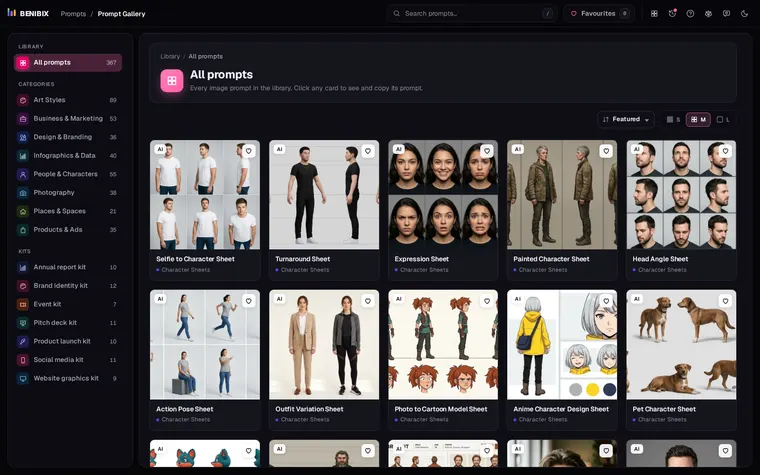
Prompt Gallery has every prompt in this post and 547 more, 558 in all, in 9 categories and 69 tabs, each next to the image it made. Open one, press Customize to change the words, add your own details, pick an aspect ratio or apply your brand kit, then copy it into your image tool; it runs in your browser with no account.
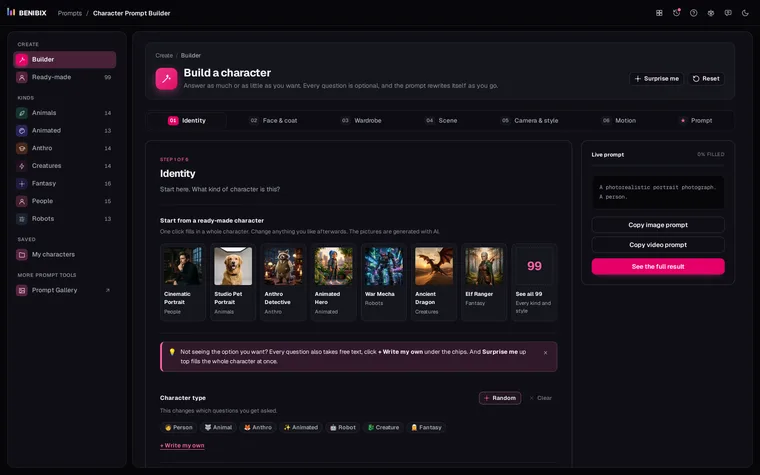
To build a character of your own instead of starting from a picture, Character Prompt Builder asks a few questions about a person, animal, creature or robot and gives you prompts for stills and video, plus an identity block that keeps the character the same in every image.